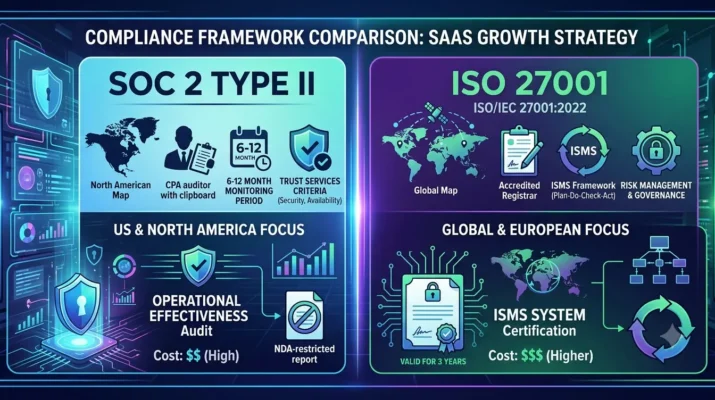
Choosing between SOC 2 Type II and ISO 27001 is one of the most critical security investment decisions a fast-growing B2B SaaS company will face. Both frameworks validate your enterprise security posture, but they serve different markets, carry distinct cost structures, and require different internal commitments.
While SOC 2 Type II remains the gold standard for doing business in the North American B2B ecosystem, ISO 27001 provides an internationally recognized Information Security Management System (ISMS). Understanding the operational, financial, and strategic differences between the two ensures your organization targets the framework that accelerates sales cycles without overextending compliance budgets.
1. What Is SOC 2 Type II?
Developed by the American Institute of CPAs (AICPA), SOC 2 (System and Organization Controls) evaluates a service organization’s controls relevant to security, availability, processing integrity, confidentiality, and privacy—known as the Trust Services Criteria (TSC).
Unlike ISO 27001, SOC 2 is not an absolute certification. Instead, it is an independent attestation report issued by a licensed CPA firm.
- SOC 2 Type I: Evaluates the design of your security controls at a single point in time.
- SOC 2 Type II: Evaluates the operational effectiveness of your controls over a specified observation period (typically 6 to 12 months).
Key Characteristics of SOC 2
- Primary Region: Highly favored in the United States and Canada.
- Flexibility: Controls are customized based on your specific infrastructure and technology stack.
- Deliverable: An extensive audit report containing the auditor’s opinion, tested controls, and specific test results, which enterprise prospects review under NDA.
2. What Is ISO 27001?
ISO/IEC 27001 is an international security standard jointly published by the International Organization for Standardization (ISO) and the International Electrotechnical Commission (IEC). It specifies the requirements for establishing, implementing, maintaining, and continually improving an Information Security Management System (ISMS).
Rather than auditing individual control outcomes alone, ISO 27001 assesses whether your organization has a structured risk management process in place to identify, mitigate, and govern data security risks continuously.
Key Characteristics of ISO 27001
- Primary Region: Globally recognized standard (Europe, APAC, and international enterprise deals).
- Structure: Prescriptive management framework combined with 93 specific control sets listed in Annex A (updated in ISO 27001:2022).
- Deliverable: A formal certificate valid for 3 years, subject to annual surveillance audits.
3. Direct Comparison: Cost, Timeline, and Scope
| Feature / Metric | SOC 2 Type II | ISO 27001 |
| Primary Geographic Market | United States & North America | Global (Europe, Asia, LATAM, US) |
| Audit Type | Attestation Report (CPA Firm) | Formal Certification (Accredited Registrar) |
| Average Total Cost (Year 1) | $30,000 – $85,000+ | $45,000 – $110,000+ |
| Time to Completion | 6 to 12 months (includes observation) | 8 to 14 months (Stage 1 & Stage 2 audits) |
| Renewal / Audit Cycle | Annual report required | 3-Year cycle (with annual surveillance) |
| Primary Focus | Operational control effectiveness | Systematic risk management framework (ISMS) |
4. Total Cost Breakdown: What SaaS Companies Actually Pay
The cost of achieving compliance extends beyond auditor fees. A realistic Year-1 budget must account for automated compliance software, external consulting, and internal resource allocation.
| Total Compliance Cost = Auditor Fees + Automation Platform + Virtual CISO/Consultant + Internal Engineering Time |
SOC 2 Type II Cost Breakdown (Year 1)
- Auditor / CPA Fees: $15,000 – $35,000
- Compliance Automation Software (Vanta, Secureframe, Drata): $10,000 – $25,000
- Penetration Testing (Required annually): $5,000 – $15,000
- vCISO / Readiness Consulting (Optional): $10,000 – $20,000
- Total Projected Investment: $40,000 – $95,000
ISO 27001 Cost Breakdown (Year 1)
- Accredited Certification Audit (Stage 1 & 2): $20,000 – $40,000
- ISMS Software & Evidence Collector: $12,000 – $30,000
- Penetration Testing & Vulnerability Scans: $7,000 – $18,000
- Internal Audit & Readiness Consultant: $12,000 – $25,000
- Total Projected Investment: $51,000 – $113,000
5. How to Choose the Right Framework for Your Business
To decide which framework to pursue first, evaluate your current revenue goals and customer requirements:
Choose SOC 2 Type II if:
Your target customers are mid-market or enterprise US companies.
You need to close US sales pipeline deals in the next 6 to 12 months.
Prospects are explicitly requesting a “SOC 2 Type II Report” during security questionnaires.
Choose ISO 27001 if:
You are expanding into European or global international markets.
Your sales team faces stringent RFP requirements asking for a recognized security certification.
You want a repeatable, corporate-wide security governance framework.
Pursue Dual Compliance (SOC 2 + ISO 27001) if:
Over 80% of security controls between SOC 2 and ISO 27001 overlap. If you use a modern compliance automation tool, you can cross-map evidence and complete both audits simultaneously, reducing total audit costs by 30-40%.